After days of sweltering temperatures, many people are surprised when the weather suddenly changes, bringing torrential rain, booming thunder and spectacular lightning displays. While it may seem like a dramatic shift, these thunderstorms are actually one of the most common consequences of prolonged hot weather.
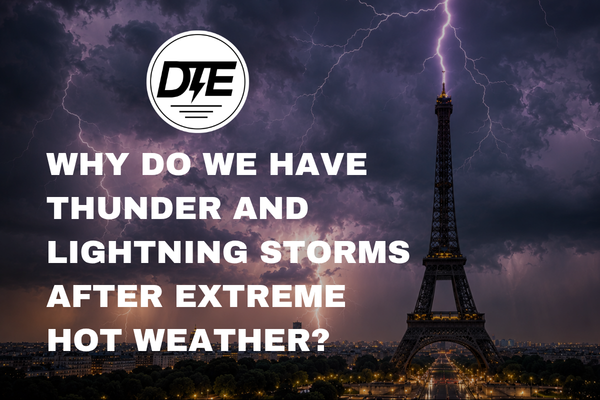
Europe’s heatwave is a perfect example. Following record-breaking temperatures across the UK and mainland Europe, on the 26th June 2026, the UK Met Office reported that there had been over 63,000 lightning strikes across the UK within 24 hours! One of the most striking images came from the French capital, where lightning struck the Eiffel Tower during an evening storm, producing spectacular photos and videos that were shared around the world.
Why does hot weather create thunderstorms?
During a heatwave, the sun heats the ground for several consecutive days. This, in turn, warms the air immediately above it. Warm air is lighter than cool air, so it rises rapidly into the atmosphere, carrying large amounts of moisture.
As this rising air reaches higher altitudes, temperatures fall, causing the water vapour to condense into towering cumulonimbus clouds (the giant storm cloud responsible for thunderstorms). Inside these clouds, ice crystals, water droplets and hailstones collide continuously, creating electrical charges.

Eventually, the difference in electric charge becomes too great, and nature balances it in the form of lightning. The lightning superheats the surrounding air to temperatures of around 30,000°C – approximately five times hotter than the Sun’s surface! This causes the air to expand explosively, creating the shockwave we hear as thunder.
Europe’s recent storms show the power of lightning
The recent heatwave across Europe demonstrated just how quickly extreme heat can turn into violent thunderstorms. As temperatures exceeded 40°C across parts of France, Spain and Italy, the unstable atmosphere produced thousands of lightning strikes across Western Europe.
One of the most widely shared images came from Paris, where the 330-metre Eiffel Tower was struck by lightning. While the strike looked dramatic, it caused no damage because the tower was specifically designed by Gustave Eiffel to withstand such events.
In fact, the Eiffel Tower is struck by lightning between five and ten times every year. Its lightning protection system includes four lightning rods mounted at its highest point, heavy-duty conductors running through the structure, a comprehensive earthing system and surge protection for its electrical equipment. The tower’s iron framework also acts as a giant Faraday cage, safely directing the enormous electrical current around the structure before dispersing it into the ground.
This is the same principle used in professionally designed lightning protection systems for commercial buildings. Rather than preventing lightning from striking, the system provides a controlled, low-resistance path that safely carries the electrical current to earth, protecting both the building and everything inside it.
Why lightning protection matters
Although lightning is fascinating to watch, it presents a genuine risk to homes, businesses and infrastructure. A single strike can damage electrical systems, destroy equipment, start fires and cause costly downtime.
As heatwaves become more frequent and intense, the conditions that produce thunderstorms are also becoming more common. Investing in a professionally designed lightning protection system and keeping it maintained will ensure your building is safe when nature is at its most unpredictable.
The recent strike on the Eiffel Tower serves as a reminder that lightning cannot be prevented, but with the right protection in place, its immense power can be safely managed.
Leave a Reply