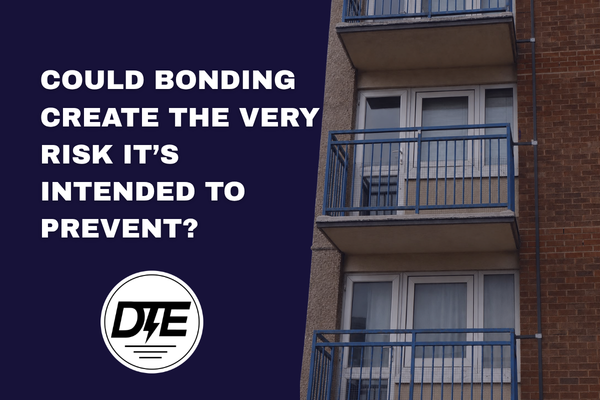
A single photograph on LinkedIn recently sparked one of the most interesting discussions we’ve seen within the lightning protection industry—it showed a down conductor bonded directly to a metal balcony. Most engineers looking at the image probably wouldn’t have questioned it, so why did it spark a discussion?
Bonding nearby metallic items has been considered good engineering practice for decades, but a few simple questions changed the conversation: “Was the bond actually required?” And perhaps more importantly, “Could that bond introduce a risk that didn’t previously exist?“
These questions initiated a debate about modern lightning protection design, the separation distance calculations, equipotential bonding and whether some long-standing installation practices deserve another look.
For generations, engineers have worked to a straightforward principle: If two conductive parts sit close together, lightning current may flash between them. Bonding both items together reduces the voltage difference between them, helping to prevent dangerous side flashes. That’s why countless buildings across the UK have metallic handrails, cable trays, structural steelwork and pipework bonded into the lightning protection system. The thinking has always been simple: If in doubt, bond it.
Today’s standards have introduced a much more engineering-led approach: rather than automatically bonding nearby metalwork, BS EN IEC 62305 requires designers first to determine whether bonding is actually necessary.
That means considering factors such as:
- Lightning Protection Level (LPL)
- Separation distance calculations
- Conductor routing
- The position of the metallic item
- Whether the item enters the building
In many cases, these calculations demonstrate that bonding remains essential, but in others, they may show that adequate separation already exists—if that’s the case, bonding may offer little additional benefit.
Unnecessary bonding can introduce dangerous lightning energy into critical electrical equipment and provide a route into the structure. This poses a huge fire risk, not to mention risk of damage to the equipment and the structure itself, as well as endangering its occupants. If that bonded metalwork is readily accessible to occupants, questions naturally arise about whether additional protective measures should be considered.
Many contractors still adhere to the old ‘1 metre rule’, which was when all metal work within 1 metre of a conductor was bonded into the system. It’s important to know that this is from the previous and now obsolete standard of BS 6651 and no longer applies. Standards evolve, and so must our procedures and processes when out on site, and old practices, no matter how lucrative, must be challenged.
The LinkedIn discussion highlighted an important point: photographs rarely tell the whole story. Without understanding the complete lightning protection design, the building’s construction, the calculated separation distances and the reasoning behind the installation, it’s impossible to determine whether the arrangement shown was appropriate or not. A handrail positioned next to a down conductor on one building may require bonding; on another building, an identical handrail may not. Good lightning protection design has never been about applying identical solutions to every installation. It’s about understanding the engineering behind each one.
Perhaps the most thought-provoking part of the discussion wasn’t the photograph itself, but how many engineers recognised similar situations they’ve encountered, handrails bonded without calculations, plant equipment connected “just in case”, solar panel frames bonded without the use of air terminals, etc. The list goes on; none of those examples are automatically incorrect, but they do raise an important question: Are some bonding decisions based on engineering or tradition?
Perhaps the first question should not be, “Where can we add another bond?” Instead, it should be, “Does this actually require bonding?” Only after considering the separation distance calculations and the requirements of BS EN IEC 62305 can that question be answered correctly. In some situations, direct bonding will provide the safest solution; in others, maintaining the required separation distance may be more appropriate. The decision should be based on engineering judgement and compliance with the standard—not routine practice.
At Down-to-Earth, we believe the lightning protection industry benefits enormously from discussions like this, not because they prove one side right and the other wrong, but because they encourage engineers to think more deeply about why they make certain design decisions. Standards continue to evolve; engineering knowledge continues to improve. Perhaps our greatest responsibility is not simply to follow accepted practice but to continually question whether accepted practice still represents the best engineering solution. After all, the safest lightning protection system isn’t necessarily the one with the most bonds; it’s the one that’s been designed with the greatest understanding.
What do you think?
Have you ever come across a bond that you believed was completely unnecessary? Or have you seen examples where bonding clearly prevented a dangerous situation?
We’d love to hear your thoughts in the comments.
Leave a Reply