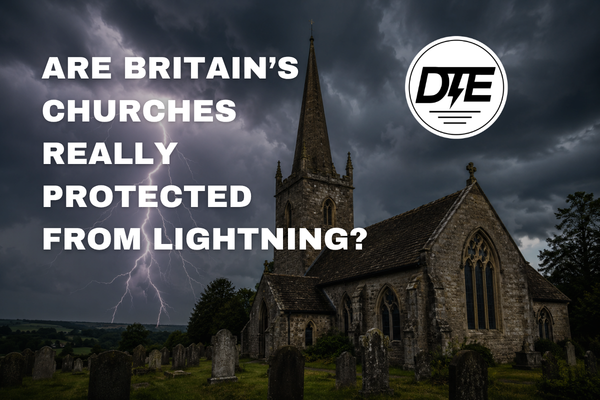
For centuries, church spires have dominated the British skyline. Historically, they were often the tallest structures in their local area and, as a result, naturally vulnerable to lightning strikes. Throughout history, many churches have suffered devastating damage, from fires and structural failures to the destruction of irreplaceable heritage assets.
Today, thousands of churches across the UK are fitted with lightning protection systems intended to safeguard these historic buildings. But a simple question has recently sparked considerable debate within the lightning protection industry: How many churches in Britain are actually protected to modern standards?
At first glance, the answer appears straightforward. Most churches across Britain have some form of lightning protection, and many have had it for decades. The more important question, however, is whether those systems provide the level of protection expected under today’s standards.
Many church lightning protection systems were installed to earlier standards, such as CP326 or BS 6651. A typical installation often consisted of a single air termination (lightning rod) on the highest point of the building, and usually one down conductor and earth. While some churches have multiple air terminations and down conductors, they are frequently not installed as the fully interconnected system expected under BS EN 62305. Likewise, surge protection devices protecting incoming electrical and telecommunications services are uncommon in older installations.
For that reason, many specialists believe that very few historic church lightning protection systems would fully satisfy the recommendations of today’s standard without some degree of upgrading.
That is where the debate begins…
Some professionals argue that the vast majority of churches already have adequate lightning protection and remain compliant with the standards applicable to them. Others believe that if those same churches were assessed against today’s standard, BS EN 62305, only a small proportion would fully meet the current recommendations without significant improvements.
The debate highlights a wider issue affecting not only churches, but thousands of older buildings throughout the UK.
What exactly do we mean when we say a lightning protection system is “compliant”?
Many church lightning protection systems were installed 40, 60 or even 100 or more years ago. They were designed to the standards, knowledge, and technology available at the time, long before modern concepts such as formal risk assessments, coordinated surge protection, and separation distances became standard practice.
Naturally, systems designed decades ago were never intended to satisfy all of these requirements. That does not necessarily mean they are completely ineffective. However, it does raise important questions about how they should be assessed today.
In other words, the debate is not about whether churches have lightning protection. Most do. The debate is whether those systems deliver the level of protection that would be expected if they were designed today.
One of the most overlooked aspects of this discussion is the position of those responsible for maintaining churches. Most churchwardens, volunteers, trustees and parish councils are not lightning protection specialists.
They are often responsible for:
- Roof repairs
- Heating systems
- Electrical installations
- Insurance requirements
- Historic preservation
At the same time, they are expected to make decisions about highly technical lightning protection systems and understand standards that most people have never heard of. As a result, they rely heavily on the advice provided by specialists. This places a significant responsibility on inspectors and contractors to communicate clearly, honestly and without bias.
A recurring theme within the debate is the distinction between compliance and protection. When a church receives a certificate following inspection and testing, what does that certificate actually mean?
To many clients, the answer is simple: “My church is protected from lightning.”
However, the reality may be more complicated. A system may comply with the standard under which it was originally installed while falling short of modern recommendations. The building may have a certificate, but the question is whether it has the level of protection that would be expected if it were designed today – those are not always the same thing.
Unlike modern commercial buildings, churches present unique challenges. Historic stonework, listed-building restrictions, conservation requirements, architectural significance and budget limitations can all influence what upgrades are practical. In many cases, bringing a church fully in line with modern standards may require extensive alterations that are costly, difficult to approve, or potentially damaging to the character of the building. This means decisions often involve balancing heritage preservation against risk reduction. There are rarely simple answers.
Ultimately, the most important question may not be: “Does our lightning protection system comply with the standard it was installed to?”
Instead, it may be: “Does our lightning protection system provide an acceptable level of protection for our church today?”
That is a very different conversation which moves beyond paperwork and compliance certificates and focuses on the real purpose of lightning protection: safeguarding people, property, electronic equipment and heritage.
In conclusion, the debate surrounding church lightning protection is about far more than churches. It highlights a broader challenge facing the entire industry: how we assess ageing systems in a world where standards, technology and our understanding of risk continue to evolve.
Britain’s churches deserve more than assumptions. They deserve informed decisions based on honest assessments, competent inspections, and a clear understanding of both historic installations and modern expectations because when lightning strikes, it is not the certificate that protects the building, it is the lightning protection system itself.
“When lightning strikes, paperwork won’t save you. Performance will!”
Leave a Reply