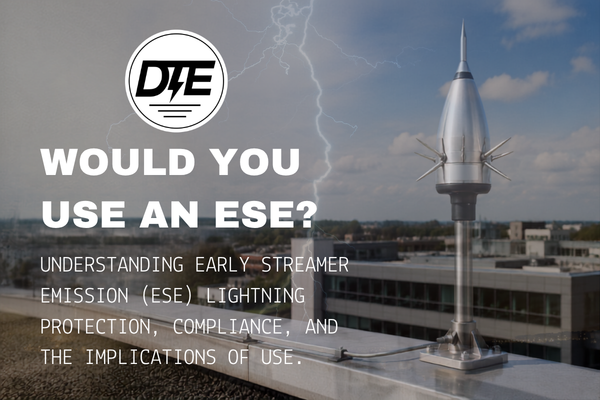
WOULD YOU USE AN ESE?
For a long time, there has been controversy in the lightning protection industry about whether ESEs should be used on structures.
Early Streamer Emission (ESE) lightning protection systems are a specialised type of lightning rod designed to launch an upward leader earlier than conventional air terminals, with the intention of capturing lightning strikes at a greater distance. They are widely marketed as offering enhanced protection coverage, often reducing the number of air terminals required on a structure. However, their regulatory status varies significantly across Europe, and this creates technical, legal, and insurance implications for their use.
In France, ESE systems are formally recognised under national standards, most notably NF C 17-102. This standard sets out design, testing and installation requirements for ESE air terminals and allows them to be used as part of a certified lightning protection system. As a result, ESE installations are relatively common in certain sectors in France and other countries that adopt a similar framework, such as Spain and parts of Asia. Proponents argue that they offer cost savings and wider protection radii compared with traditional Faraday cage and Franklin rod systems.
In contrast, in the UK and across much of Europe, aligned with CENELEC standards, ESE systems are not recognised within the principal lightning protection standard, BS EN 62305. This standard governs risk assessment, design, and installation of lightning protection systems and is widely used as the benchmark for compliance in the UK. Within BS EN 62305, only conventional air-termination systems are considered valid. ESE technology is not included due to concerns about its theoretical basis, performance validation, and lack of sufficiently robust, independently replicated field evidence.
This divergence creates a grey area in practice. Despite not being recognised under BS EN 62305, ESE systems are still installed in the UK and elsewhere, often driven by client preference, perceived cost benefits, or international project specifications. Some manufacturers continue to promote them as “equivalent” or “advanced” alternatives, even though they are not accepted within mainstream UK compliance frameworks.
The implications of this are significant. From a compliance perspective, a building fitted with ESE terminals alone may not meet the requirements of BS EN 62305. This can affect building certification, especially for critical infrastructure, high-occupancy buildings, or sites where formal lightning risk assessments are mandatory. In effect, the system may be considered non-compliant even if it appears to offer protection.
Insurance is another key concern. Many insurers require compliance with recognised national standards when assessing lightning protection adequacy. If a loss occurs and the installed system is based on ESE technology not recognised by BS EN 62305, insurers may question whether due diligence was followed. This could potentially lead to disputes over liability, reduced payouts, or increased premiums, particularly where compliance with recognised standards was a policy condition.
There are also engineering liability considerations. Designers and installers specifying non-standard systems may assume professional risk if the protection system is later challenged. In regulated environments, reliance on non-recognised technology can expose duty holders to scrutiny under health and safety or building control frameworks.
Ultimately, the use of ESE systems sits at the intersection of engineering innovation, regulatory acceptance, and risk management. While they remain legally permissible in some contexts, their exclusion from BS EN 62305 means their use requires careful justification, transparent communication with stakeholders, and a clear understanding of potential compliance and insurance consequences.
Here at Down-to-Earth, we heavily believe in following the guidelines set out in BS EN 62305, so we are of the opinion that ESEs should not be used in the UK. For more on ESEs, you can read Chapter 11: Early Streamer Emitters (ESE) and Lightning Protection Standards in The Down-to-Earth Guide to Lightning Protection Testing and Inspection.
Leave a Reply